Chapter 2
Timeline of Invasion
A chronological record of the Umayyad conquest of Sindh, documenting the trail of destruction from 711 CE to 715 CE.
A chronological record of the Umayyad conquest of Sindh, documenting the trail of destruction from 711 CE to 715 CE.
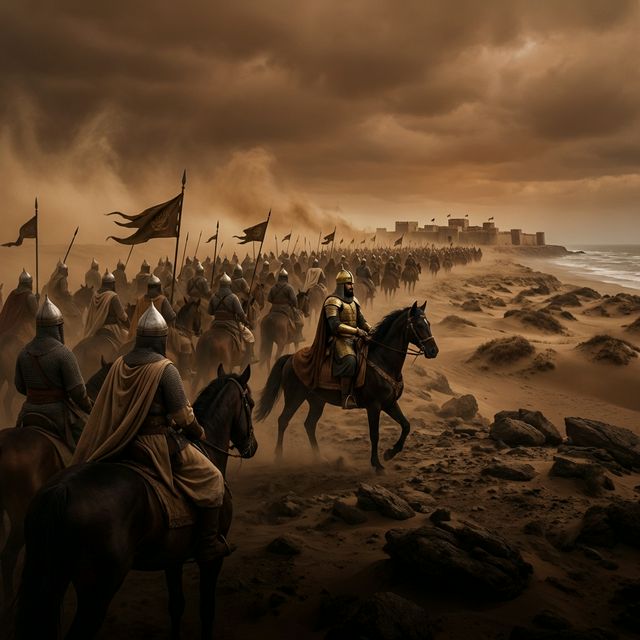
Over a period of four years, Muhammad bin Qasim led the Umayyad forces from the coastal port of Debal all the way up the Indus River to Multan. This was not a peaceful integration; it was a violent military subjugation that fundamentally altered the history of the Indian subcontinent. The timeline below chronicles the major events of this ruthless campaign.
Location: Damascus / Makran Coast
Previous attempts by the Umayyad Caliphate to conquer Sindh had failed, resulting in the deaths of Arab generals. Using the pretext of pirates capturing vessels off the coast of Debal carrying gifts and women from Ceylon to the Caliph, Hajjaj bin Yusuf (governor of Iraq) secured permission from Caliph Al-Walid I to launch a massive, well-equipped retaliatory invasion under his 17-year-old nephew and son-in-law, Muhammad bin Qasim.
Location: Port of Debal (near modern Karachi)
Supported by a massive catapult named Urus ("The Bride"), Qasim's army besieged the great port city. Upon breaching the walls, Qasim implemented Hajjaj’s ruthless orders. A general massacre lasting three days was ordered. All males capable of bearing arms were executed. The city's massive Hindu/Buddhist temple was desecrated, its red flag torn down, and thousands of women and children were enslaved to be sent back as the Caliph's share (khums).
Location: Nerun (Hyderabad) & Sehwan
Witnessing the terrifying fate of Debal, several local Buddhist governors and priests of Nerun surrendered the city to avoid massacre, agreeing to pay the humiliating Jizya tax. Qasim then advanced to Sehwan (Siwistan). After a brief siege, the city fell. A heavy tribute was extracted, and the subjugation of the local population was formalized under Umayyad administration.
Location: Rawar / Aror
Crossing the Indus River using a pontoon bridge constructed of boats, Qasim engaged the royal army of Sindh led by Raja Dahir. In a fierce battle, Raja Dahir was struck by an arrow, fell from his elephant, and fought until he was slain. His head was severed and sent to Hajjaj as a trophy. His queen, Rani Ladi, and other royal women committed Jauhar (self-immolation) to avoid capture and enslavement by the invading army.
Location: Brahmanabad
Following the king's death, the defense of Brahmanabad was led by Dahir’s son, Jai Singh. When the fort eventually fell, the Umayyad forces enacted another wave of brutal collective punishment. According to native accounts compiled in the Chachnama, between 6,000 and 16,000 men were executed. Thousands more were condemned to slavery. It was here that two daughters of Raja Dahir, Surya Devi and Parimala Devi, were captured and sent as "gifts" to the Caliph in Damascus.
Location: Multan
Marching into the Punjab region, Qasim besieged the heavily fortified city of Multan. After cutting off the city's water supply, the defenders were forced to surrender. The famous ancient Sun Temple of Multan was plundered. The loot acquired here was so staggering in quantity—mountains of gold and precious gems—that the Arabs dubbed Multan the "City of Gold." The temple's idol was desecrated and left as a symbol of Umayyad dominance.
Location: Sindh & Damascus
For the remaining two years, Qasim worked to consolidate Arab rule over the vast territory, imposing the Jizya tax and expanding borders toward Gujarat and Kashmir. However, imperial politics in Damascus caught up with him. Following the deaths of Hajjaj and Caliph Al-Walid, the new Caliph Sulayman—an enemy of Hajjaj—recalled Qasim. The young conqueror was arrested, imprisoned in chains in Wasit (Iraq), and tortured to death at the age of 20.
In just four years, Muhammad bin Qasim systematically dismantled the ancient Hindu-Buddhist civilization of Sindh. The campaign resulted in the deaths of tens of thousands, the mass enslavement and deportation of native women and children, the targeted destruction of pivotal temples from Debal to Multan, and the institutionalization of second-class citizenry (dhimmis) through the Jizya tax. The wealth drained from the subcontinent during this short period was astronomical, fundamentally shifting the economic balance of the era.