🏰
The Siege of Debal (711 CE)
The port city of Debal was the first major target. Muhammad bin Qasim's forces arrived by land
and sea, bringing a massive catapult known as Urus ("The Bride"), which required 500
men to operate.
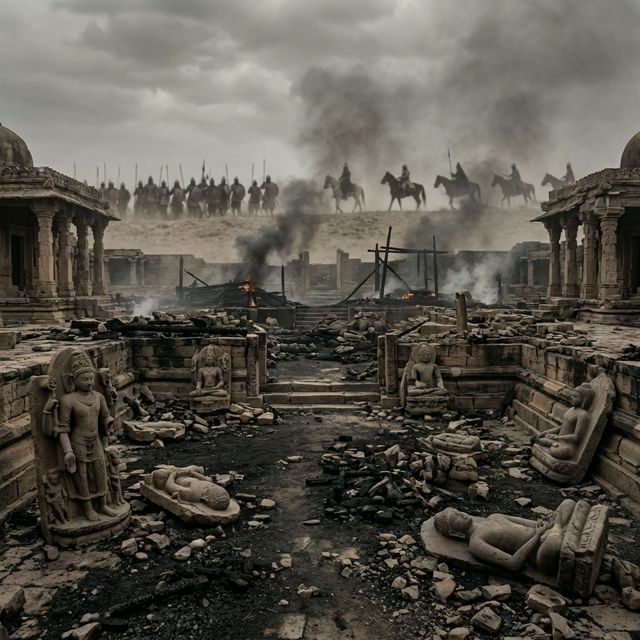
The city's defense was centered around a magnificent Hindu/Buddhist temple topped with a giant
red flag. Qasim targeted the flag, and its destruction demoralized the defenders. Once the walls
were breached by the siege engines, the real horror began.
The Three-Day Massacre: Upon entering the city, Qasim executed the direct
orders of Hajjaj bin Yusuf. For three days, a general massacre was conducted. All males deemed
capable of bearing arms (17 years and older) were killed. The temple was desecrated, the priests
executed, and the surviving women and children were taken as slaves. The immense plunder was
divided: one-fifth (the khums) was sent to Hajjaj and the Caliph in Damascus, alongside
tens of thousands of slaves, while the rest was distributed among the soldiers.
🐘
The Battle of Rawar (712 CE)
The decisive battle of the conquest took place near Aror. Raja Dahir, the Brahmin king of Sindh,
assembled his forces to stop the Umayyad advance. The battle was fierce, and the native army
fought with desperate bravery against the veteran Arab cavalry.
Dahir led his troops from atop his war elephant. When a naphtha arrow fired by the Arab forces
struck Dahir's elephant, the beast panicked and plunged into the river. Though Dahir managed to
remount and fight on horseback, he was isolated, surrounded, and slain.
The Jauhar of Rani Ladi: Dahir's head was severed to be sent as a trophy to
Iraq. The remaining forces retreated to the fort of Rawar, commanded by Dahir’s queen, Rani Ladi
(or Bai). Recognizing that defeat was inevitable and knowing the horrific fate of enslavement
and rape that awaited them, the Queen and the women of the royal household committed
Jauhar—mass self-immolation in a massive pyre—preferring death over dishonor.
⚔️
The Slaughter at Brahmanabad
Following Dahir's death, the resistance was sustained by his son, Jai Singh, at Brahmanabad. The
siege dragged on for months, exhausting both sides until a betrayal from within forced the
city’s surrender.
Despite promises of quarter given by some commanders, Qasim adhered to the doctrine of absolute
subjugation. The surviving defenders faced merciless retaliation.
Decimation of the Defenders: The Chachnama explicitly records the toll
of Brahmanabad. Between 6,000 and 16,000 fighting men were systematically executed in the
aftermath of the siege. Their dependents were enslaved. It was here that two daughters of Raja
Dahir, Surya Devi and Parimala Devi, were captured and sent as slaves to the Caliph's harem—an
event that would ultimately seal Qasim's own fate.
☀️
Multan: The City of Gold (713 CE)
Pushing northward into the Punjab region, Qasim reached the strongly fortified city of Multan.
The city held out for two months until an informant revealed the source of the city's water
supply. Qasim cut off the water canal, forcing the garrison to surrender.
Multan was famous throughout the subcontinent for its magnificent Sun Temple, which housed
unimaginable wealth donated by pilgrims over centuries.
The Ultimate Plunder: The wealth looted from the Sun Temple of Multan was so
staggering that the Arabs renamed it Faraj Bayt al-Dhahab (The Frontier House of Gold).
Mountains of gold, silver, and precious gems were extracted. A massive idol made of pure gold
with ruby eyes was desecrated. A piece of cow's flesh was tied to the idol's neck to humiliate
the native worshippers before the wealth was shipped back to Damascus.