Chapter 1
The Official Narrative
What your textbooks say about Muhammad bin Qasim — and what they deliberately cover up to sanitize history.
What your textbooks say about Muhammad bin Qasim — and what they deliberately cover up to sanitize history.
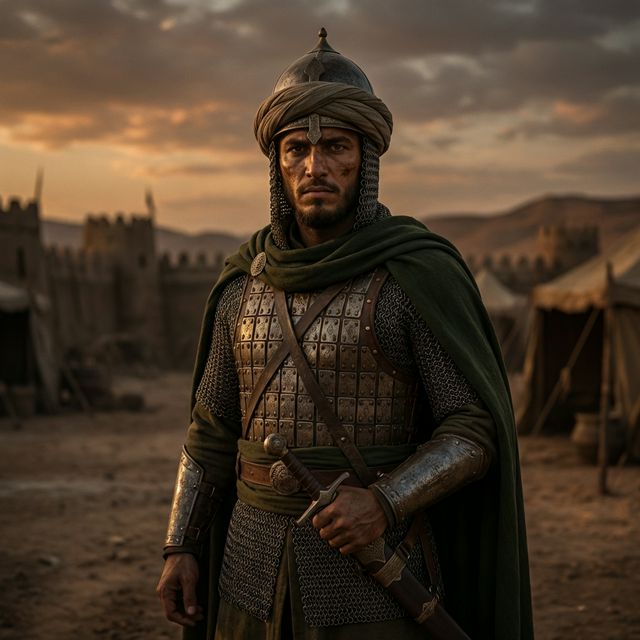
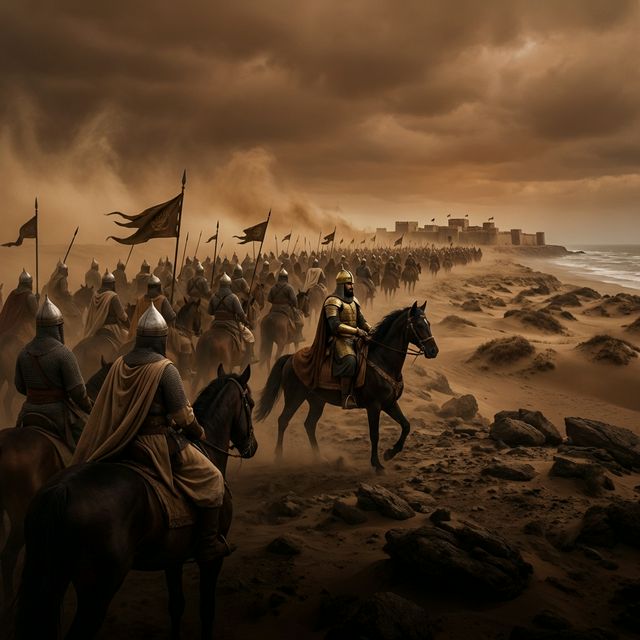
In many school curricula across the subcontinent, Muhammad bin Qasim is introduced not as an imperial conqueror, but as a righteous savior. The narrative often taught is that of a young, noble general sent merely to rescue captive Muslim widows and orphans from the clutches of evil pirates off the coast of Sindh, under the oppressive rule of Raja Dahir.
He is regularly presented as a "harbinger of peace," a "just administrator," and the man who brought the "light of civilization" to the Indian subcontinent.
This framing is not merely an exaggeration; it is a deliberate distortion of documented facts.
What these textbooks carefully omit is the brutal reality recorded in the very texts that document his campaign, most notably the Chachnama. The invasion of Sindh was an expansionist imperial campaign marked by mass slaughter, the execution of surrendering defenders, the systemic destruction of native political power, and the mass enslavement of tens of thousands of Hindu and Buddhist women and children.
The sanitized historical curriculum presents Muhammad bin Qasim with the following framing:
Notice the framing: His brutal military campaign is reduced to a rescue mission. The massacres are entirely erased. The systemic taxation (Jizya) placed upon non-Muslims is spun as a benevolent "protection fee." The thousands sent back to the Caliphate as slaves are simply erased from history.
The textbook narrative suggests Qasim only punished the pirates. The Chachnama records a very different reality. When the port city of Debal was breached, Qasim ordered a general massacre of the inhabitants. For three consecutive days, the Umayyad army slaughtered all males capable of bearing arms (often cited as age 17 and above). The city's wealth was plundered, and its surviving women and children were taken as slaves.
After defeating the remnants of Raja Dahir's army at Brahmanabad, the slaughter continued. According to historical chronicles, between 6,000 and 16,000 fighting men were executed after the siege. By some calculations, the total number of combatants and civilians killed across Sindh reached into the tens of thousands.
A standard practice of the Umayyad conquests was the extraction of the khums—one-fifth of the war booty, which was sent back to the Caliph in Damascus. In the context of Sindh, this "booty" heavily comprised human beings. Following the capture of Aror and Multan, tens of thousands of captive native women and children were marched across the desert as slaves to the slave markets of the Middle East, fundamentally altering the demographic structure and devastating families across the region.
Textbooks claim Qasim brought "religious freedom." In reality, he implemented the Jizya, a humiliating poll tax levied exclusively on non-Muslims (Hindus and Buddhists) simply for the right to live and practice their faith in their own ancestral land. Those who could not pay or refused to submit faced severe penalties, pushing much of the impoverished populace into forced conversion.
The primary source for this period, translated into Persian by Ali Kufi, provides unvarnished accounts of the brutality. It notes that Hajjaj bin Yusuf, the governor of Iraq and Qasim's uncle, explicitly instructed him:
The active minimization of Muhammad bin Qasim's violent conquest is a textbook example of historiographical manipulation serving modern political agendas.
This whitewashing operates through several mechanisms:
Understanding the true nature of Muhammad bin Qasim's invasion is critical, because 711 CE marks the geopolitical fracture of the Indian subcontinent.
When an invader who slaughtered native populations, enslaved thousands, and imposed discriminatory religious taxation is taught to generations of students as a hero and a "liberator," it creates a profound civilizational schizophrenia. It normalizes the erasure of indigenous suffering and glorifies the perpetrators of historical atrocities.
We cannot understand the socio-political dynamics of modern South Asia without acknowledging the violent inauguration of this conflict in the 8th century.